For hundreds of years, the halls of the national academies and the galleries of major museums had been almost solely inhabited by the art and stories of men. But as Britain leapt forward into the Modern era, the work of female artists was beginning to break ground. By the middle of the twentieth century, women had become major players in this male dominated world, leaving a lasting legacy that is still felt today.
Showcasing works from the Lakeland Arts collection, this post explores the contributions of six trailblazing female artists. From sculpture to landscapes, portraits to still lifes, these women played a key role in shaping Modern British art.
← Self Portrait (1952) by Hilde Goldschmidt (1897-1980)
↑ Conversation (1992) by Bridget Riley b. 1931
Barbara Hepworth was one of the most critically acclaimed sculptors of her generation.
Her dynamic approach to carving had a significant impact on British art, heralding an era of fluid, abstract forms.
Hepworth’s primary interest was the way in which people occupy their landscapes, a fascination she acquired as a young child growing up in the West Riding. Driving with her father along Yorkshire’s winding roads, she was struck by the way the rolling hills appeared to blend seamlessly into the industrial towns. Two complete opposites, in harmony with one another.
Much of her work focuses on the relationship between people and nature, with humanistic forms evolving out of organic shapes. ‘Torso III (Galatea)’ was inspired by a stranger she saw whilst travelling in Greece. She recalled, ‘with that incredible stretch of sea and islands before me – how intensely a figure rising in the distance expressed that perfect elaveation of the human spirit’.
Torso III (Galatea) (1958) by Barbara Hepworth (1903-1975)→
Dame Elizabeth Blackadder is a Scottish painter and printmaker, who became the first ever woman to be elected to both the Scottish Academy and the Royal Academy.
She is celebrated for her ability to capture the joy of nature, from her intricate flower still lifes to her rolling northern landscapes.
From a young age, Blackadder expressed a keen interest in nature and plants. She spent much of her teenage years scouring the local landscape, collecting specimens of plants which she then pressed into books. The hours she spent pouring over these specimens translated to an almost scientific understanding of the subjects she would paint, evidenced by the extraordinary level of detail that can be found within her work.
‘Northumbrian Landscape with Hadrian’s Wall’ showcases another of Blackadder’s artistic strengths: her ability to use negative space to dramatic effect. The detail of Hadrian’s wall is dwarfed by the vastness of its surroundings, establishing the endless, isolated moorland as the true focus of the painting.
← Northumbrian Landscape with Hadrian’s Wall (1960-61) by Elizabeth Blackadder b. 1931
‘Winnifred Nicholson was a true colourist. Her delicate still lifes are an exploration into the full spectrum of colour, capturing both tone and light in revolutionary way.
Her approach to painting had a lasting impact on some of the leading artists of her generation, including Ivon Hitchens, Christopher Wood and her husband, Ben Nicholson.
Her signature compositions are a unique amalgamation of still life and landscape. They often consist of floral arrangements set against the backdrop of the Cumbrian hills, viewed through the window of her Westmorland home. For Nicholson, no other subject served the exploration of colour as well as this –
‘I have tried to paint many things in many different ways, but my paintbrush always gives a tremor of pleasure when I let it paint a flower … to me they are the secret of the cosmos.’
Amaryllis (1967) by Winifred Nicholson (1893-1981) →
Celia Paul is a deeply personal painter. Her haunting depictions of close friends and family members explore the difficult and emotional subjects of grief, isolation and longing.
Her ability to capture these emotions through the use of colour and light has made her one of Britain’s most respected artists.
Paul’s work is dominated by her close familial ties. Her most frequent sitters were her mother and her sister Kate, with whom she held incredibly close bonds.
With each and every portrait, Paul captures a unique glimpse into the lives and emotions of her sitters. In Study: My Mother and the Cross, Paul’s mother is bathed in light from a window, its panels forming the shape of a cross. The cross references her mother’s deep religious devotion, which brought her great comfort in the final years of her life.
← Study: My Mother and the Cross (2001) by Celia Paul b. 1959
LAT_2003_001-REGO-P-Triptych-left-hand-panel
LAT_2003_001-REGO-P-Triptych-left-hand-panel
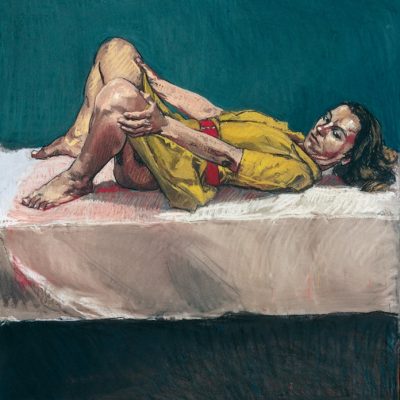
LAT_2003_001-REGO-P-Triptych-centre-panel
LAT_2003_001-REGO-P-Triptych-centre-panel
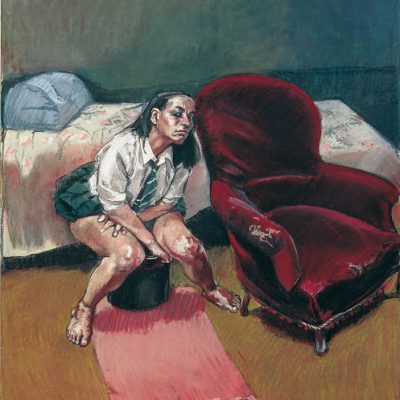
LAT_2003_001-REGO-P-Triptych-right-hand-panel
LAT_2003_001-REGO-P-Triptych-right-hand-panel
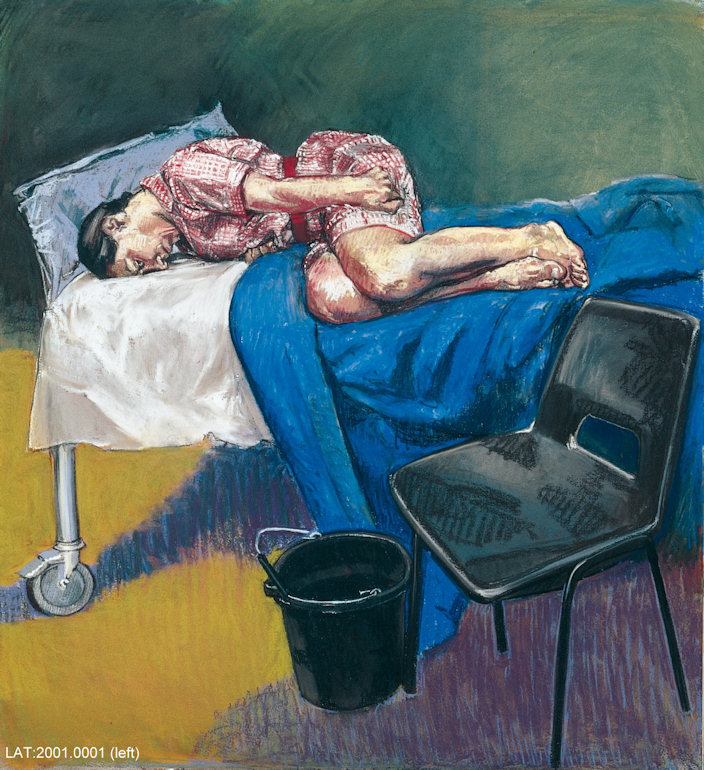
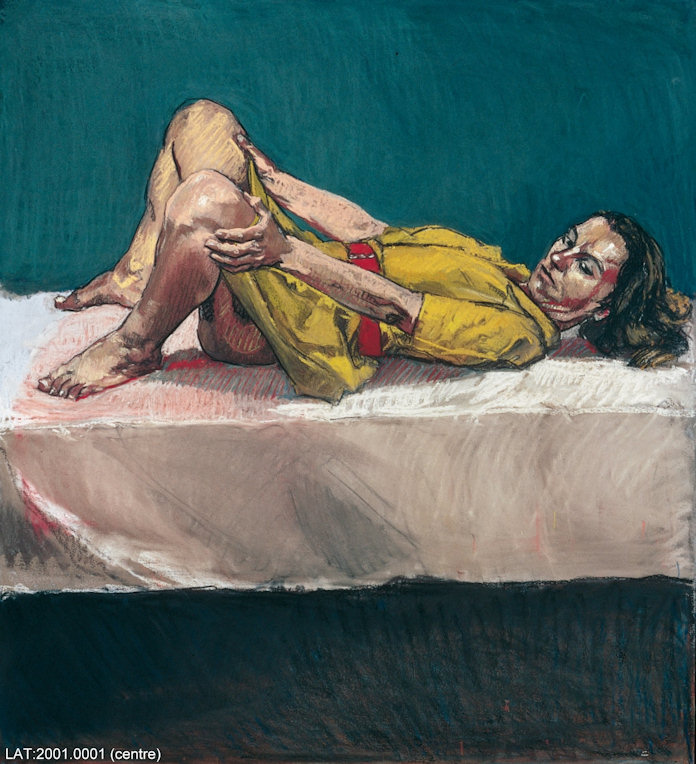
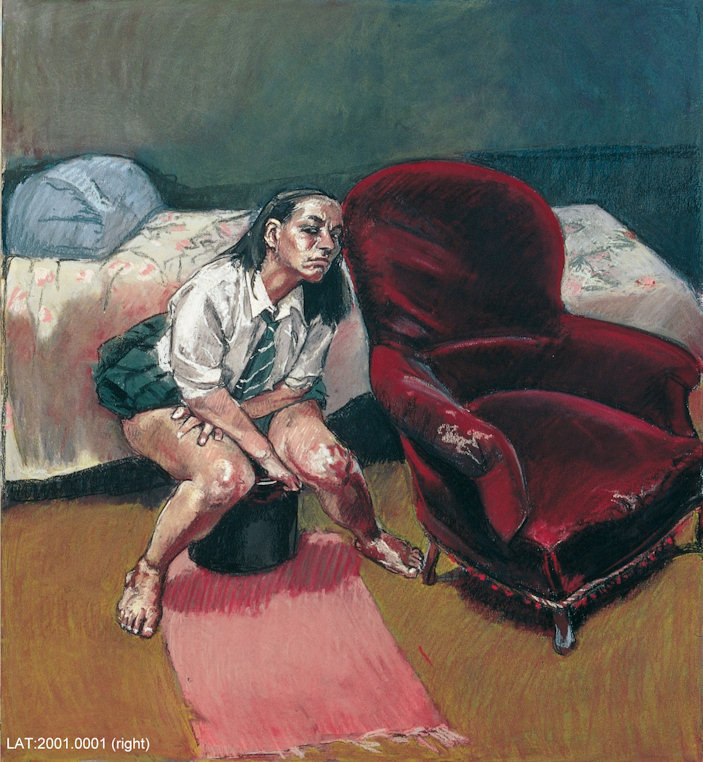
Paula Rego is a Portuguese-born artist who moved to Britain in 1951 to study at the Slade School of Art.
Her powerful and moving works highlight the social injustices faced by women in society, placing her at the vanguard of modern, feminist art.
Much of Rego’s art is inspired by her childhood in Portugal, a staunchly Catholic nation, then under the fascist Salazar regime. From an early age, she was troubled by the growing lack of humanity she saw around her, from racist fascist rhetoric to controlling religious views. After moving to Britain, she felt a moral need to capture these injustices, and her work stands as a portfolio for some of society’s most uncomfortable truths.
‘Triptych’ is part of a series that Rego created in 1998, in response to Portugal’s referendum on the abolition of its abortion laws. Rego is seeking to portray the suffering that such laws inflict, forcing many women into unsafe procedures.
Bridget Riley is a pioneering artist whose explorations into colour and line helped to found the 1960’s Op-Art movement.
Her unique works are experiments into the science of seeing, which trick and intrigue the eye through optical illusions.
Riley’s iconic style was inspired by Pointillism, an avant garde technique developed by the French artist Georges Seurat. Seurat’s Pointillist paintings are made up of tiny dots of colour, which, when viewed from a distance, create a solid image. Fascinated by the ability of the human eye to rearrange what it sees, Riley began creating her psychedelic works, which appear to move and transform the longer you look at the canvas.
‘The amazing thing of perception in action’, she said, is ‘the work is absolutely still, but you, by looking, you move it.’
← Conversation (1992) by Bridget Riley b. 1931
Love Abbot Hall?
We hope you’ve enjoyed this digital exhibition
Abbot Hall is run by Lakeland Arts and your support makes everything we do possible. As a charity, we rely on support from visitors and other individuals, trusts, foundations, public organisations and the corporate sector. This support helps us achieve our mission: to inspire all to explore and enjoy the arts, heritage and outstanding places we care for.
Every donation of any size makes a difference.