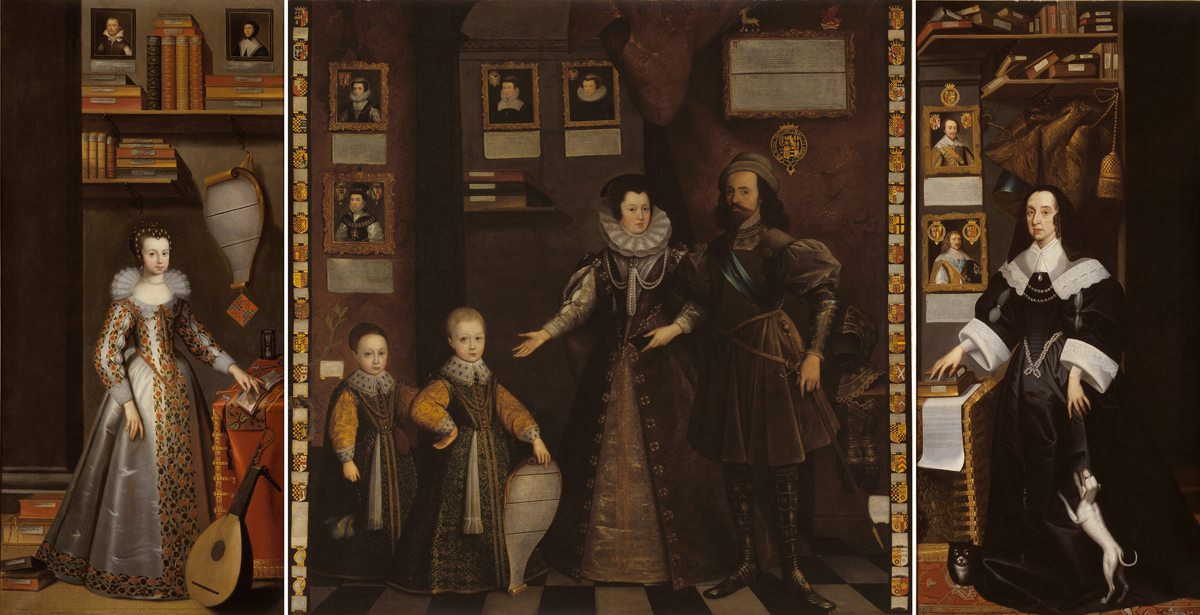
The Great Picture, 1646
Oil on canvas
254cm x 254cm (centre panel); 254cmx 119.4cm (each side panel); 254cm x 492.8cm (total)
The Great Picture is a remarkable triptych, a three-sectioned painting typically used for religious works. It was commissioned by Lady Anne Clifford in 1646 when she finally received the inheritance that she had fought for throughout her life and always felt was rightfully hers.
The painting is full of minute detail that gives the family history and accomplishments of Lady Anne Clifford (1590–1676) using a combination of portraiture, text and symbolism. Every book cover, coat-of-arms and scroll can be read, and all the portraits are of people Lady Anne knew.
Lady Anne Clifford was born in 1590, the daughter of Margaret Russell and George Clifford, third Earl of Cumberland. She was 15 years old when her father died; he left the Clifford estates not to Lady Anne, his only surviving heir, but to his brother Francis. It was until the death of the last of Francis’ heirs in 1641 that Lady Anne finally inherited the estates of Westmorland and Yorkshire.
When Lady Anne left London for the north of England in 1649, she found that many of her castles were in ruins, and her estates in great need of repair. She wasted no time in rebuilding her castles at Skipton, Appleby and Brougham, as well as repairing neighbouring churches and settling long running disputes with her tenants. She continued to enjoy the fruits of her inheritance and hard work for the remaining 27 years of her life. She was a greatly respected figure at the time of her death in 1676.
The Great Picture was purchased through a private treaty sale with the assistance of the Victoria and Albert Museum Purchase Grant Fund, the National Heritage Memorial Fund, the Art Fund (Fulham Fund), Eden District Council, Appleby Town Council, Cumbria County Council, South Lakeland District Council, Kendal Town Council, Furguson Industrial Holdings, Greenwood Charitable Trust, Granton Investments, Dalemain Estates and other generous donations, 1981.
In more detail...
- The young Lady Anne
Lady Anne is shown here at the age of 15, her age when her father died and she was effectively disinherited.
This likeness of Lady Anne was based on a miniature portrait still in her possession at the time of the painting’s execution. It has been suggested that the dress she is wearing is based on the ‘sea water green satin’ garment that she ordered in 1617 after emerging from mourning following her mother’s death the previous year.
- Accomplishments
There are several symbols within the painting that allude to Lady Anne’s accomplishments. Her musical ability is suggested by the sheet music at her left-hand fingers, as well as the lute at her feet. Beneath the music is some half-finished embroidery – a pursuit fitting for an aristocratic lady of 15 years of age. All the while, the hourglass reminds us that even for a young woman the sands of time are constantly flowing away.
- Lady Anne’s library
The books that are arranged all around Lady Anne allude to her learning. The titles are clearly visible, and the painting contains many of the great reference books and works of fiction that had been written up to that point. Some, in fact, had not even been published at the time of Lady Anne’s 15th birthday: the English translation of Miguel de Cervantes’ Don Quixote did not appear until 1612.
- Lady Anne’s story in words
Throughout the triptych, detailed texts recount the narrative of Lady Anne’s ancestry and serve to reassert her rights as inheritor of the Clifford estates. The texts are probably by Lady Anne herself, while the scribe who transferred them to canvas is not known. It has been suggested that it was her officer, Edward Langley, who had written much of the Great Books of Record. These enormous volumes were also written by Lady Anne as a declaration of her ancestry.
- Portrait of Samuel Daniel
Samuel Daniel (1562–1619) was Lady Anne’s tutor. He was also a published poet and historian: his works are included in her library.
- Portrait of Anne Taylor
This portrait is of Lady Anne’s governess, Anne Taylor. She may have been connected to the Clifford’s by marriage and was the daughter of Mr Cholmley, a London merchant.
- Lady Anne’s parents
The central panel depicts Lady Anne’s parents and older brothers immediately preceding her birth. Her father, George Clifford, 3rd Earl of Cumberland (1558–1605) was a favourite at Queen Elizabeth’s court and sailed to the New World with Sir Walter Raleigh. He is shown wearing armour from a later period.
Her mother, Margaret Russell, Countess of Cumberland (1560–1616) had served as a Maid of Honour to Queen Elizabeth. Up until her death Margaret remained a firm defender of Lady Anne’s inheritance rights.
- Older brothers
Lady Anne’s two brothers both died young. The older, Francis, Lord Clifford, died in 1589 at five years of age, while the younger, Robert, died a year after Lady Anne’s birth, leaving her as the only direct heir to the Clifford Estates.
- Lady Anne’s aunts
These portraits show both Lady Anne’s paternal aunts – Frances Clifford and Margaret Clifford, Countess of Derby – as well as her maternal aunts, Anne Russell, Countess of Warwick, and Elizabeth Russell, Countess of Bath.
- Lady Anne’s first husband, Richard Sackville
Lady Anne married the handsome courtier Richard Sackville, 3rd Earl of Dorset, in 1609. His family was well connected at court and the family seat at Knole became Lady Anne’s home. Sackville was charming and good-looking, but extravagant. This indulgent lifestyle caused tension between the couple. He died at the age of 35, leaving some sixty thousand pounds in debts for his successor, his brother Edward, to repay. After his death Lady Anne said she did not intend to remarry, but six years later she changed her mind and married Philip Herbert, 4th Earl of Pembroke.
- Lady Anne’s second husband, Philip Herbert
Philip Herbert, 4th Earl of Pembroke, was active in the courts of James I and Charles I, whom he served as Lord Chamberlain. He was considered a man of influence though he had a reputation for being violent. It is clear he was not an easy person to get on with, and after five years of marriage Lady Anne began living apart from him. He did, however, help her in pursuing her claim to her lands. He was a great patron of the arts and commissioned artists such as Anthony van Dyck and William Larkin to paint his portrait. It is the van Dyck portrait from which his likeness in The Great Picture is taken.
- The books in disarray
In the right-hand panel of the triptych Lady Anne’s books are shown in a state of confusion in contrast to the ordered library depicted in the left-hand panel. This relates to the ruinous state of her northern castles, churches and estates following the English Civil War. The neatly stacked copy of Henry Wotton’s Elements of Architecture on the far right of the shelf hints at the rebuilding program that Lady Anne undertook to restore her estates to their former glory.
- Lady Anne at 56
This portrait shows Lady Anne at the age of 56, when she finally came into possession of her hereditary lands and commissioned The Great Picture to commemorate the occasion. It is the only part of the triptych which was painted from life and became the model after which many head-and-shoulders copies were made. Lady Anne had copies painted to give to her family members and dependants.
- Lady Anne’s cat
After the marriage and departure in 1647 of her daughter, Isabella Sackville, Lady Anne’s plump cat would have been a valued companion. We know that Lady Anne had cats¬: a statement of accounts of her household instructs that a certain amount per day was to be allotted to providing food for the cat. This cat resembles an owl – the ancient symbol of wisdom – and is clearly well fed.
[insert page=’block-become-a-member’ display=’content’]