
To accompany our current exhibition Something in Common, we have put together a reading list including research for the exhibition by artist James Fox, food for thought around the role of craft in society and inspiring books for younger readers too.
We have provided our own recommendations which you can purchase from our craft and design shop at Blackwell, plus a few more suggested by the artist himself.
Our recommendations
The Women who saved the English Countryside – Matthew Kelly
- Matthew Kelly traces the history of landscape preservation through the lives of four remarkable women: Octavia Hill, Beatrix Potter, Pauline Dower, and Sylvia Sayer. From the commons of London to the Lake District, Northumberland, and Dartmoor, these women protected the English landscape at a crucial period through a mixture of environmental activism, networking, and sheer determination.
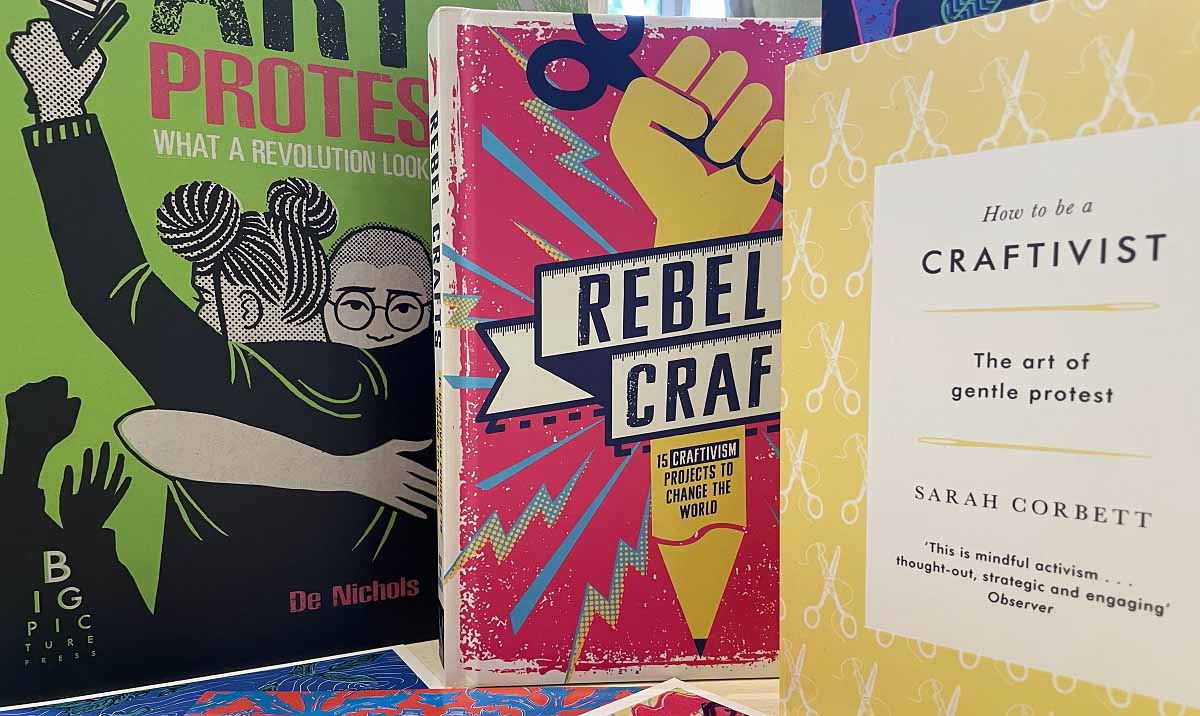
How to be a Craftivist – Sarah Corbett
- Is a manifesto for quiet activism: how to tackle issues not with shouting and aggression but with gentle protest, using the process of ‘making’ to engage thoughtfully in the issues we are about, to influence and effect change.
Street Craft – Riikka Kuittinen
- Brings together twenty-eight different artists from different countries whose work has redefined what street art can be. By diversifying materials and techniques, Street Craft artists are pushing beyond the two-dimensionality of graffiti and mural-painting, many of them using craft techniques to bring inventive beauty to bland urban surroundings.
The Trespassers Companion – Nick Haye
The Trespasser’s Companion is a short, celebratory and urgent book about the land and our access to it. It is a call to adventure, a love letter to nature and, because in England we are excluded from 94% of the land, a gently seditious guide to trespass. With brilliant immediacy Nick Hayes shows how we can reclaim our lost connection to the land.
Art of Protest, what a revolution looks like – De Nichols
“Start making. Start being the change you want to see in this world.” De Nichols From the psychedelic typography used in ‘Make Love Not War’ posters of the 60s, to the solitary raised fist, take a long, hard look at some of the most memorable and striking protest artwork from across the world and throughout history.
Rebel Crafts – Hester Van Overbeak
- From hand-painted signs and stickered slogans to knitted hats and radical badges, craft and protest have always gone together. Combine your passion for making with your desire to make your voice heard with 15 step-by-step craftivism projects. Rebel Crafts is a fun and informative collection of activism-inspired activities created by experienced crafter Hester van Overbeek.

 From James Fox “some of the reading that influenced the work in my show.”
Stop, Thief! The Commons, Enclosures, and Resistance – Peter Linebaugh
- Celebrated historian Peter Linebaugh takes aim at the thieves of land, the polluters of the seas, the ravagers of the forests, the despoilers of rivers, and the removers of mountaintops.
Inglorious: Conflict in the Uplands – Mark Avery
- Presents the case against driven grouse shooting. Driven grouse shooting is a peculiarly British fieldsport. It is also peculiarly British in that it is deeply rooted in the British class system.
George Orwell Essays – George Orwell
- A collection that brings together Orwell’s longer, major essays and a fine selection of shorter pieces that includes ‘My Country Right or Left’, ‘Decline of the English Murder’, ‘Shooting an Elephant’ and ‘A Hanging’.
Who owns England?: How We Lost Our Green and Pleasant Land, and How to Take It Back – Guy Shrubsole
- Who owns England? Behind this simple question lies this country’s oldest and best-kept secret. This is the history of how England’s elite came to own our land, and an inspiring manifesto for how to open up our countryside once more.
Wayfinding: The Science and Mystery of How Humans – M. R. O’Connor
- In this compelling narrative, O’Connor seout neuroscientists, anthropologists and master navigators to understand how navigation ultimately gave us our eks humanity.
New Model Island: How to Build a Radical Culture Beyond the Idea of England – Alex Niven
- Niven argues that the map of the British Isles should be torn apart completely as we look towards a time of radical political reform. Rejecting outdated nationalisms, Niven argues for a renovated model of culture and governance for the islands.
